Thirty-one years under other people's houses taught me the ugly part: most of what you would pay me to come out and do is a six-dollar part, twenty minutes, and knowing the order to check things in. That order has never been written down for homeowners. So I wrote it down.
"There is no money in a homeowner who knows what a fill valve is."
Why nobody in the trade taught you thisI spent thirty-one years in residential service. Not new construction, where the walls are open and the work is clean — service. The phone rings, somebody is upset, I drive over and crawl under their house. I have been under enough of them that I stopped counting somewhere in the second decade.
In all that time I kept noticing the same thing. Roughly nine calls out of ten were the same twenty or so problems, over and over, in different houses. A flapper. An aerator. A slip nut somebody had cross-threaded. A chain a half inch too long. Work I could have talked a homeowner through on the telephone in ten minutes, if the trade worked that way. It does not. I get paid to drive over.
So here is the list. Twenty-four repairs, written in the order you will actually meet them, each chapter built the same way so that once you have read one you know where to find things in all the rest — because when water is running across a floor, you should not have to hunt.
Every chapter opens with a strip: how hard the job is, how long it takes, what the parts cost. Then the mechanism in plain words, because somebody who understands the mechanism can diagnose a problem I never anticipated. Then what you need. Then the fix, in numbered steps, written the way I would talk you through it standing at your elbow.
Then the two sections most books leave out, which I consider the most valuable pages in here. What this does not fix — the failures that look identical from the outside but have a different cause, so you do not spend Saturday on the wrong repair. And when to stop — the specific signs that the job has become somebody else's.
Gas is one of those. Anything inside a wall is another. A sewer lateral is a third. When we get to them I say stop, and I mean stop. I included those chapters anyway — so you understand what is happening, what it should cost, and what a good contractor will do, and cannot be sold something you do not need.
Anybody can turn a nut. What thirty-one years buys you is knowing which thing to check first, and what it means when that was not it.
The full contents of the First Edition, illustrated throughout.
Three chapters to read tonight, while nothing is broken.
The most common call in the trade, and the cheapest to fix.
What clears it, what never will, and the one sign you must not ignore.
Including the one part in your house most likely to flood it.
Why it trickles, why it runs cold, and what the banging is.
The trade habits, and how the invoice is actually built.
"The toilet had been running for two years and I had stopped hearing it. Chapter four, twenty minutes, one flapper from the hardware store. The next water bill was forty-one dollars lower."
Ray M.Ohio"I read chapter one the night I bought it and went and tagged the main. Three weeks later a supply line under the guest bath let go while we were home. Ninety seconds. One towel."
Denise K.Texas"What I did not expect was the chapter on how plumbers price work. I got a quote, knew which questions to ask, and the second company came in two hundred under the first for the same job."
Walt H.Oregon
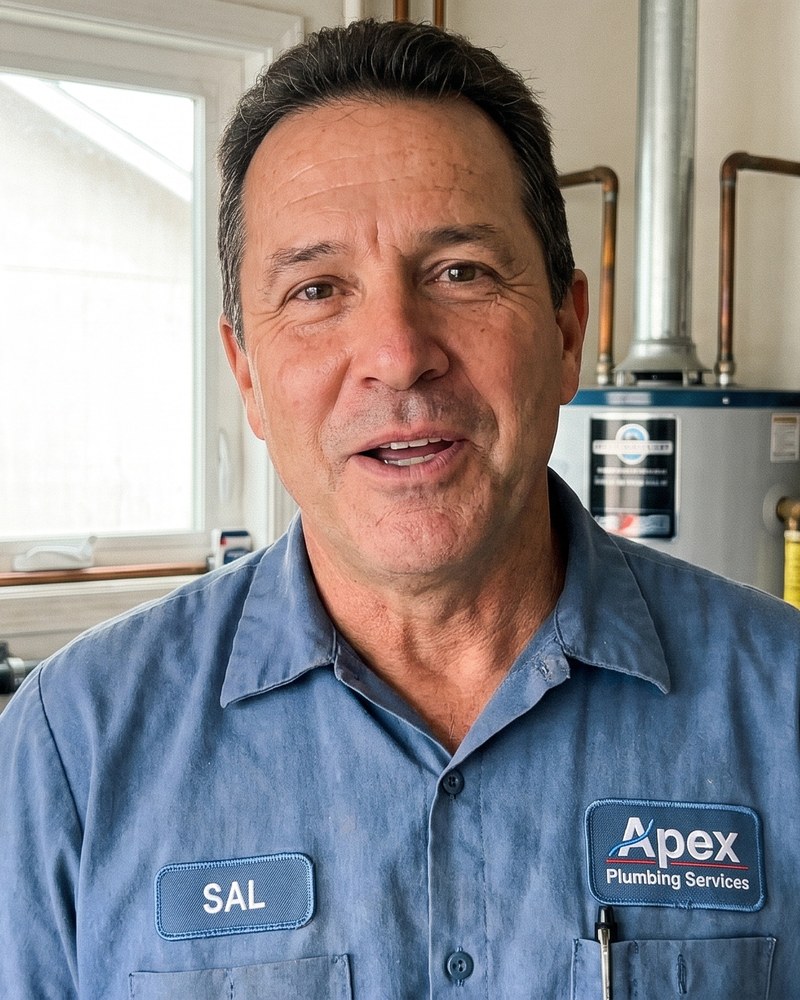
My name is Sal Piper. Thirty-one years in residential service plumbing, most of it on my back with a flashlight in my teeth. I did not do new construction. I did the other thing — the call at eleven at night from somebody standing in a flooding bathroom holding a towel, wondering why nobody ever taught them this.
I am going to be straight with you the whole way through, including the parts where being straight costs me the sale. I will tell you when a job is genuinely simple, and most of them are. I will tell you what it costs in parts, to the dollar, so you know before you get in the truck. I will tell you the order to check things in, because that is the actual skill — not the wrenching, the sequence.
And I will tell you, clearly and without hedging, when to put the tools down and pick up the phone. There are jobs in a house that will hurt you, flood you, or cost you ten times what a service call would have.
I will also tell you when something you have read on the internet is wrong, or half right, or right for the wrong reason. There is a great deal of confident nonsense out there, and some of it will cost you a ceiling.
The book is dedicated to every homeowner who stood in a flooding bathroom at eleven at night, holding a towel, wondering why nobody ever taught them this.
Sal Piper First Edition · 2026The Veteran's Checklist for Diagnosing and Fixing 9 Out of 10 Household Plumbing Problems

It is a working manual, written out of thirty-one years of residential service calls — the mechanism, the parts cost, the sequence, and the stopping point. It is not a code manual and it is not a substitute for a licensed plumber on the jobs where I tell you to call one. Where I say stop, I mean stop.
A video shows you one repair on one fixture. This is the whole list, in order, with the diagnosis in front of it — and the Symptom Index that takes you from what you are hearing to the right chapter without watching twenty minutes to find out it was not your problem. It also has the two things a video never has: what the fix does not cover, and when to stop.
Because a diagnostic call alone runs $70 to $150 in most of the country before anybody touches a wrench, and the first chapter you use pays for the book several times over. I priced it where a homeowner would not have to think about it. $47 is where it goes when the launch promo ends.
A PDF, 159 pages, illustrated. It opens on a phone, a tablet, a laptop or a Kindle, and it prints — the Symptom Index and the Maintenance Calendar are laid out as sheets worth printing and taping inside a cabinet door. Instant download, yours forever.
No. Every chapter is rated one of three ways — do it yourself, doable with care, or call a licensed plumber — and most of the book is the first. Those jobs need no experience: if you can follow a recipe you can do them, and nothing in them can flood the house or hurt you if you get it wrong.
Then you have lost nothing, which is the whole point of the ordering. Every chapter ends with when to stop: the specific signs the job has become somebody else's. Calling a plumber after you have eliminated four causes is not a defeat — it is the most efficient call he will take all week, and you will not be sold work you do not need.
A plumber's diagnostic charge runs $70 to $150 in most of the country before anybody touches a wrench. The whole manual — all twenty-four repairs, the Symptom Index, the parts costs to the dollar — is $27 during the launch promo.
Get the Manual — $47 $27